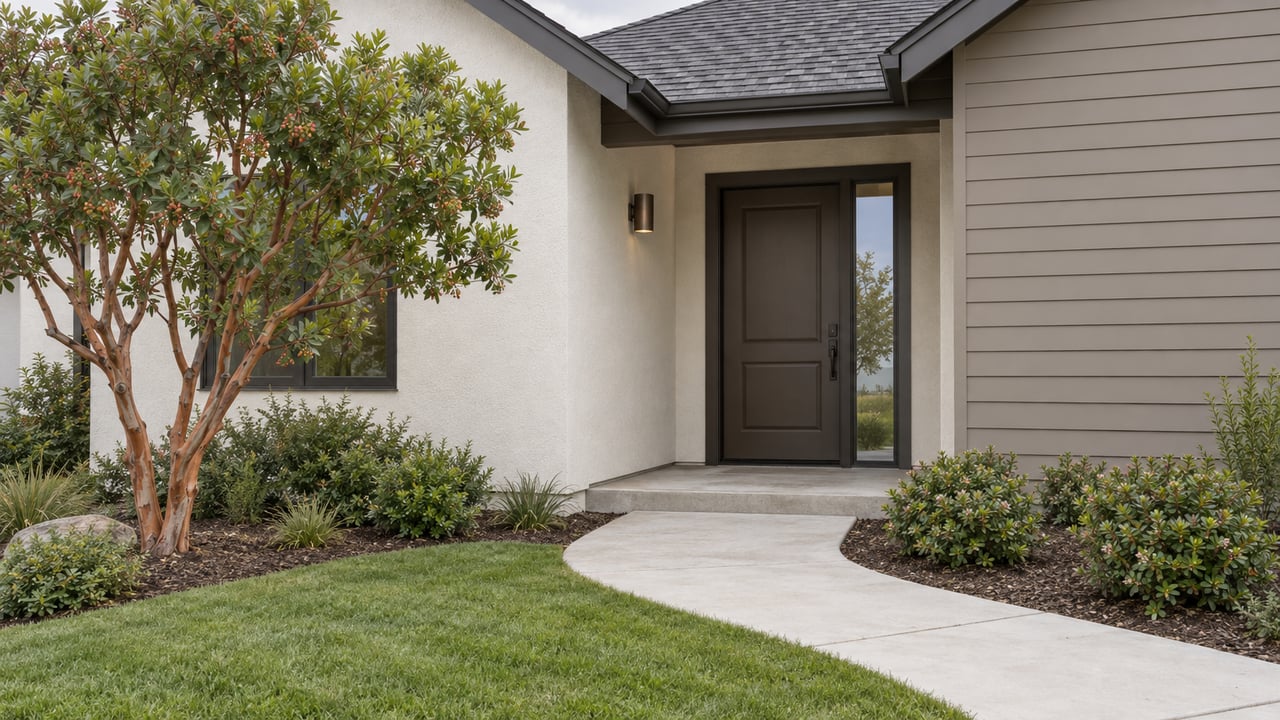
Brentwood's New-Construction Boom Has Three Builders, and Only One Skips the HOA
October 1, 2026
October 1, 2026
A four-bedroom Shea Homes house at Orchard Grove and a four-bedroom Trumark Homes house at Apricot Estates can land within a few hundred square feet of each other, both new, both in Brentwood, both marketed with nearly identical language about open-concept kitchens and modern living. One of them comes with a monthly homeowners association bill for the life of your ownership. The other one, per the builder's own buyer FAQ, has no HOA at all. Nothing about the square footage tells you which is which.
That is the part that gets lost when new construction gets treated as a single category. Right now, Brentwood has three active builder communities selling homes at the same time, and each one has structured its costs and its sales process differently enough that comparing them by price per square foot alone misses the more important math.
Shea Homes is building Orchard Grove, a community of single-family detached homes ranging from about 3,029 to 4,118 square feet, with four floor plans, four to five bedrooms, 3.5 to 4.5 baths, and two- to three-car garages. Solar comes included. In April 2026, Shea Homes Northern California picked up the BIA Bay Area Sales and Marketing Council's MAME Award for Detached Community of the Year, with Orchard Grove named as the winning community. As of this writing, Shea is advertising up to $30,000 in incentives on quick move-in homes at Orchard Grove, though builder incentives shift without much notice and should always be confirmed directly before anyone treats them as a fixed number.
A few minutes away, Trumark Homes launched sales at Apricot Estates with a grand opening on July 26, 2025. The community will eventually include 57 single-family detached homes, with three two-story floorplans reaching up to 4,397 square feet, four to five bedrooms, 3.5 to 4.5 baths, and three- to four-car garages, some with Next-Gen suites built for multigenerational households. Homes here have started around $1.175 million. The community sits along the Sand Creek Trail, next to a Sand Creek Sports Complex the City of Brentwood has planned for the adjacent land, with three multi-use sports fields, play areas, a basketball court, and pump tracks.
Then there is The Meadows at Marsh Creek, also a Shea Homes project, but built for a different buyer entirely. This is a gated 55+ community of 140 duet-style homes, meaning attached duplex-style units, ranging from about 1,633 to 1,772 square feet with two to three bedrooms and two-car garages. One recent Plan 1 listing at 1,633 square feet priced at $698,827, well under either of the family-sized communities on a per-home basis, even though the per-square-foot math tells a more complicated story once you factor in what that price does and doesn't include.
Three builders, three products, all currently selling in the same city. That much is straightforward. The part worth slowing down on is what each one attaches to the sale beyond the house itself.
The instinct with new construction is to assume more amenities and more polish means more in ongoing fees, and that a no-frills product means no HOA. Brentwood's current lineup breaks that assumption.
Apricot Estates, the largest and most expensive of the three family-sized options, carries no HOA. Trumark's own buyer FAQ for the community states this directly: there is no homeowners association at Apricot Estates. That means no shared amenity to maintain, no board, and no monthly assessment tied to landscaping or common areas, but it also means whatever community infrastructure exists is limited to what the city itself builds and maintains, like the neighboring Sand Creek Sports Complex.
The Meadows at Marsh Creek runs the opposite way. Assessments start at $398 per unit in the community's first phase and are set to climb to $447 per unit once the community reaches full buildout, with Shea Homes subsidizing any amount above $447 in the meantime. That fee funds a clubhouse that is still under construction, one meant to include a community kitchen, a pool, an outdoor spa, two pickleball courts, a community garden, and dog parks. Buyers moving in now are paying into an amenity package they can see rendered in marketing materials but cannot yet use in person.
Orchard Grove sits in the middle of this picture in a different way. Shea's own materials for the community do not spell out a specific HOA figure the way they do for The Meadows, and the emphasis instead lands on the home itself, the four floor plans, the included solar, and the $30,000 incentive on move-in-ready inventory. For a buyer comparing all three, that difference in how each builder frames its costs is itself useful information about what each company expects buyers to prioritize.
None of this makes one structure better than another. A no-HOA community shifts more of the maintenance decision-making onto the individual homeowner. A phased HOA at a still-under-construction clubhouse means paying ahead of the amenity actually existing. Both are legitimate tradeoffs. Neither is obvious from a listing sheet unless someone goes looking for it.
The fee structure isn't the only place these builders diverge. How they actually sell a home differs enough to catch buyers off guard if they walk in expecting a standard negotiation.
Trumark's process at Apricot Estates runs on a priority list. Buyers who want a shot at a specific homesite get added to the list, and when Trumark releases new homes for sale, typically on a Saturday afternoon, the community sales manager calls prospective buyers in the order they appear on that list. Buyers are expected to answer the phone when it rings. If they don't, they move to the bottom of the list. If they're called and they want the home available, they have to sign a hold reservation and leave a deposit within four hours of securing it. Buyers who are waiting for a specific home they don't yet have access to can say "pass" without losing their spot, but the system rewards being reachable and ready to move quickly on a single phone call.
That is a meaningfully different experience than walking into a sales office and negotiating in real time, and it changes what preparation looks like. A buyer working with representation who understands financing pre-approval timelines, contract review, and what to ask before that call comes in is in a different position than a buyer discovering the mechanics of a builder's release process for the first time on a Saturday afternoon.
The MAME Award Orchard Grove picked up in April 2026 is a real, third-party recognition from an industry trade group, not a marketing phrase invented for a listing page. It signals that a panel of people who evaluate new-home communities across the Bay Area looked at Orchard Grove's design and execution and rated it above other detached communities that year.
What it does not signal is that pricing is fixed or that incentives disappear once a community wins recognition. Shea is still advertising incentives on quick move-in inventory at Orchard Grove as of this writing, and the same is generally true across new construction: award-winning or not, a builder's inventory levels, phase releases, and incentive structure at any given point are worth checking directly rather than assuming they've hardened into a fixed price. The city's own records show Orchard Grove was originally entitled as a 16.82-acre subdivision split into 51 single-family parcels near Lone Oak Road and Gracie Lane, a modest-sized community by regional standards, which also means inventory at any one time is limited.
None of this is an argument for one builder over another. It's an argument for asking a different set of questions than square footage and base price when comparing new construction in the same city. Does this community have an HOA, and if so, does the fee fund something that already exists or something still being built? What does the builder's actual sales process require of a buyer, and does that process reward speed, patience, or paperwork readiness? Is the incentive being advertised right now guaranteed to still be there in a month, or is it tied to specific move-in-ready inventory that could sell out first?
A builder's sales team is there to sell that builder's homes, and their contracts, incentive structures, and release processes are built with that goal in mind. Reviewing that fine print, comparing it against what a different builder down the road is offering, and understanding which fee structure actually fits a buyer's long-term plans is a different job than touring a model home.
If you're weighing Orchard Grove against Apricot Estates or The Meadows at Marsh Creek, or trying to figure out how any of Brentwood's current new-construction options stack up against resale inventory, Danielle Campbell can walk through the actual contract terms, HOA documents, and incentive structures with you before you're the one answering a Saturday afternoon phone call cold.
Stay up to date on the latest real estate trends.


I am committed to guiding you every step of the way—whether you're buying a home, selling a property, or securing a mortgage. Whatever your needs, I've got you covered.

Danielle Campbell | CA DRE# 01875600
Brentwood, CA 94513